
By Suranjan Bantupalli, MHI, MPH(c), Graduate Research Assistant II, Public Health Prepared
On the morning of my first EPID 676: Zoonotic Infections and One Health class, my professor, Dr. Laura Power, announced, “Most human diseases have zoonotic origins.” I was still half-asleep and sipping a cold protein shake. I remember thinking, “That sounds dramatic.” But by the end of the semester, it didn’t feel dramatic at all; it felt uncomfortably close to my everyday life.
Before this class at the University of Michigan School of Public Health, I honestly never spent much time thinking about where diseases come from. If someone said, “infectious disease,” I pictured crowded hospitals, coughing patients, maybe contaminated water, but not animals I might see on the street or in someone’s backyard. Animals were just…there, part of the background. I knew that “rabies comes from dogs” or that “bats can carry viruses,” but it felt like trivia, not something that should change how I walked through the world.
EPID 676 changed that quickly. In the first few weeks, we went over example after example of zoonotic infections – rabies, influenza, coronaviruses, malaria, Lyme disease, and many more. Each time, the pattern was similar: an animal host, an environmental context, and a human behavior that connected the two. What struck me wasn’t just the number of diseases that start in animals, but how ordinary the exposure pathways often were. Walking in the woods, drinking untreated water, cleaning animal waste, playing with pets – nothing about those activities sounds extreme. They sound like normal life.
As we went deeper into the One Health framework, I started to see how tightly human, animal, and environmental health are braided together. A dog isn’t just a dog anymore – it’s a potential host for fleas and ticks, maybe a bridge between wildlife and humans. A field isn’t just a field, it’s a habitat for rodents, insects, and other animals carrying pathogens I now know by name. Even a puddle or a small stream suddenly has a story: which animals passed by, what they might have shed, how that water might later reach people?
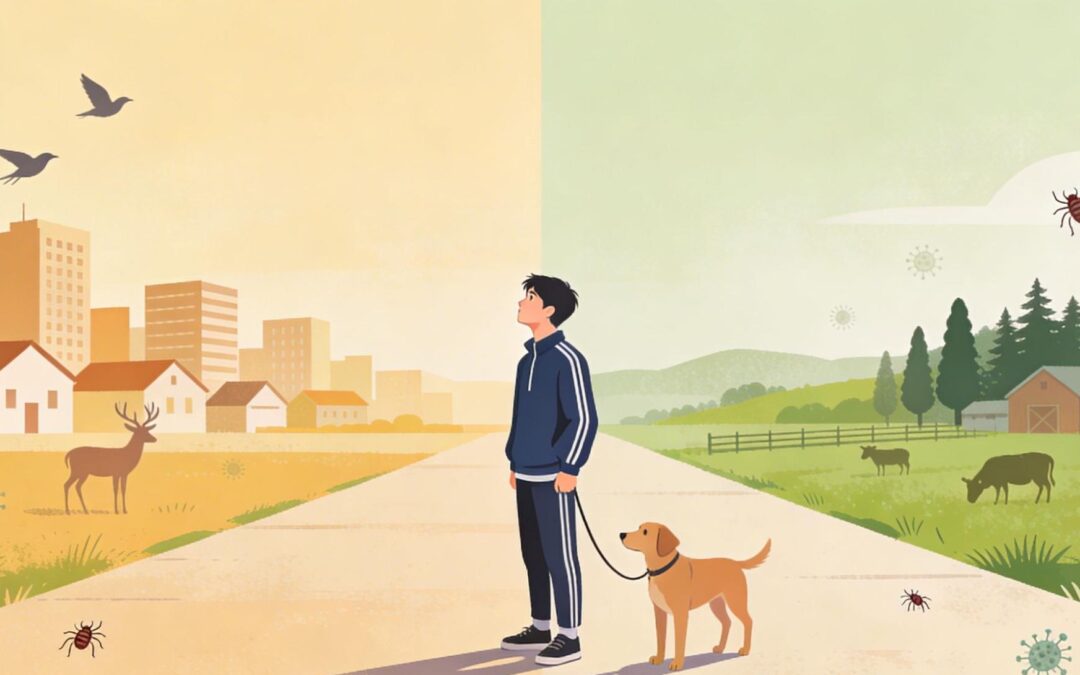
Somewhere along the way, this new awareness shifted from interesting to unsettling. I used to see a dog and think, “Cute.” Now, there are moments when my brain jumps straight to, “I wonder if it has ticks,” and then, “Ticks can carry the bacteria that cause Lyme disease,” and suddenly I’m mentally running through symptoms and transmission cycles. I find myself hesitating to pet dogs I don’t know. If one walks too close, I sometimes instinctively take a small step back, not because I dislike animals, but because my mind is busy calculating invisible risks.
It’s a strange feeling to know more and, at the same time, to feel a little more afraid. Before EPID 676, I didn’t think too hard about zoonotic diseases, so there was nothing to be anxious about. Ignorance really did feel like a kind of comfort. Now, with every lecture and every paper we read, I’m more aware of how many things have to go right for us not to get sick: how food needs to be handled, how animals need to be managed, how surveillance systems need to function, how the environment needs to be respected.
At the same time, I’m learning that this fear can be shaped into something more useful than just avoidance.
The course doesn’t stop at “here are all the ways animals can make you sick.” It also focuses on prevention, surveillance, and smarter ways of living with animals and within ecosystems.
We talk about vaccination, vector control, safe animal handling, proper food preparation, and the importance of early detection. The message isn’t “never touch a dog again,” even if some days my anxious brain tries to interpret it that way. The message is more like “understand the risk well enough to manage it.”
There’s a constant tension for me now. On one side, there’s the emotional reaction: the sudden discomfort when I see a stray dog, the mental image of unseen ticks on fur, the urge to keep my distance. On the other side, there’s the professional identity I’m building: someone who is supposed to understand risk, communicate it clearly, and help design practical ways to reduce it without shutting down normal life. I don’t want my takeaway from EPID 676 to be “all animals are scary.” I want it to be “we can live with animals more safely if we’re informed and prepared.”
What this class has really done is change the lens I use to look at the world. A walk in a park is no longer just a walk; it’s an intersection of humans, pets, wildlife, and vectors. A farm is not just a workplace; it’s a potential hotspot where animal health, human health, and environmental conditions collide. Even my own reactions, like pulling my hand back before I pet a dog, have become data points in my head about how people respond when they learn about zoonotic risks.
So now, when I remember that morning with the cold protein shake and the “dramatic” statement about most diseases coming from animals, I don’t roll my eyes anymore. I think about how much my perspective has shifted. EPID 676 didn’t just teach me about zoonotic infections, it rewired the way I see dogs, farms, forests, and even my own daily habits. I’m still figuring out how to balance knowledge and anxiety, but I can feel that I’m slowly moving from “I’m scared to touch a dog” toward “I understand the risks and use that information to inform my actions, and I can communicate these concepts to others too.”
And that, to me, feels like the real heart of One Health: not separating ourselves from animals and the environment, but learning how to share space with them more safely and more thoughtfully.
To learn more, check out these resources: